
Trading Bots
What Is Risk Management in Trading?
The Skill That Determines Long-Term Survival
Ask most new traders what makes a successful trading strategy, and you’ll often hear answers such as:
- Finding the perfect indicator
- Predicting market direction
- Achieving a high win rate
- Discovering a profitable trading bot
While these factors can be important, professional traders often focus on something else entirely:
Risk Management.
In fact, many experienced traders would argue that risk management is more important than the trading strategy itself.
A mediocre strategy with excellent risk management can survive for years.
A great strategy with poor risk management may not survive at all.
In this guide, we’ll explain what risk management is, why it matters, and how professional traders use it to protect capital and achieve long-term consistency.
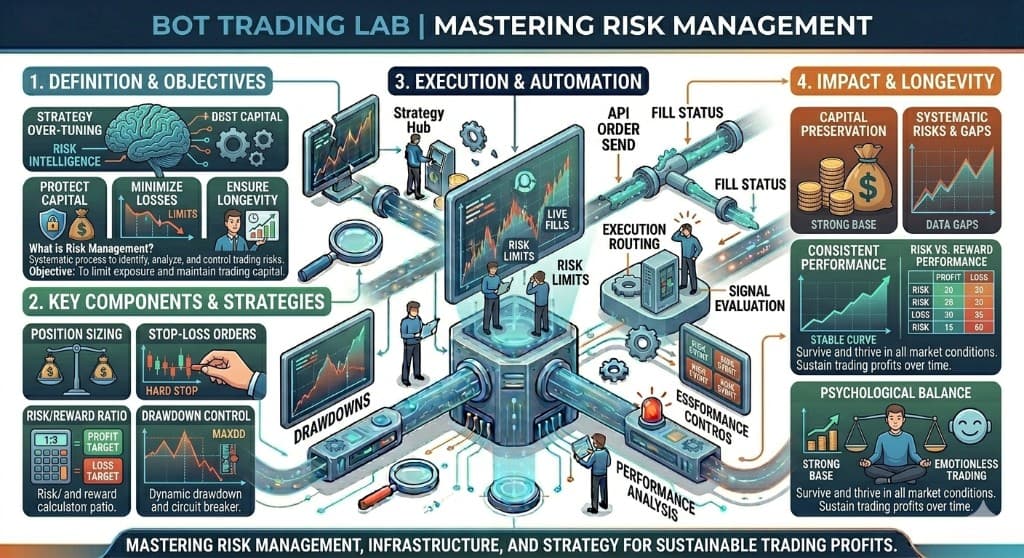
What Is Risk Management?
Risk management is the process of controlling potential losses while preserving the ability to participate in future opportunities.
In simple terms:
Risk management answers the question:
“What happens if this trade goes wrong?”
Every trade carries uncertainty.
No trader can predict the future with complete accuracy.
Risk management helps ensure that a single losing trade—or even a series of losing trades—does not cause catastrophic damage to a trading account.
Why Risk Management Matters
Most trading failures are not caused by a lack of profitable opportunities.
They are caused by excessive risk.
Common examples include:
- Position sizes that are too large
- Excessive leverage
- Lack of exposure limits
- Failure to control drawdowns
- Emotional decision-making
Even profitable traders can experience significant losses if risk is not managed properly.
The First Rule of Trading
Many professional investors follow a simple principle:
Protect capital first.
Why?
Because capital is the fuel that allows traders to continue participating in markets.
Without capital:
- There are no future opportunities.
- There are no future profits.
- Recovery becomes impossible.
Successful trading begins with survival.
Understanding Risk Per Trade
One of the most common risk management concepts is risk per trade.
This refers to how much of an account is exposed on a single position.
For example:
- Account size: $10,000
- Risk per trade: 1%
- Maximum loss: $100
If the trade fails, the account remains largely intact.
Small losses are manageable.
Large losses can be difficult to recover from.
Why Small Losses Matter
Consider two scenarios:
Trader A
- Loses: 5%
- Account recovery required: 5.3%
Trader B
- Loses: 50%
- Account recovery required: 100%
The larger the loss becomes, the harder recovery becomes.
This is one reason professional traders focus heavily on limiting downside risk and keeping drawdown under control.
Position Sizing
Position sizing determines how large a trade should be.
Many traders focus exclusively on finding trade opportunities.
Professionals often focus equally on position size.
A strong trading idea combined with excessive position size can still produce poor outcomes.
Position sizing helps balance:
- Risk
- Volatility
- Account size
- Market conditions
The Importance of Drawdown Control
Drawdown measures the decline in account value from a previous peak.
Every trading strategy experiences drawdowns.
The goal is not to eliminate them.
The goal is to keep them manageable.
Controlled drawdowns allow traders to:
- Maintain confidence
- Preserve capital
- Continue operating
Large drawdowns often create psychological and financial challenges. It helps to understand what a good drawdown looks like before judging a strategy.
Diversification
Diversification is another important risk management tool.
Rather than relying entirely on:
- One market
- One strategy
- One asset class
Traders may spread risk across multiple opportunities.
Diversification can help reduce the impact of any single market event.
However, diversification does not eliminate risk entirely.
Risk Management for Trading Bots
Risk management is particularly important in automated trading.
Trading bots execute instructions precisely.
If risk controls are poorly designed, losses can accumulate quickly.
This is one reason we avoid high-risk approaches such as grid trading, which can increase exposure as losses grow.
Professional automated systems often include:
- Position limits
- Exposure controls
- Maximum drawdown thresholds
- Trading pauses
- Volatility filters
The objective is to ensure that risk remains controlled even during difficult market conditions. The same principles apply to MT5 Expert Advisors.
Why Win Rate Is Not Enough
Many traders focus heavily on win rate.
However, a high win rate does not automatically indicate a safe strategy.
Consider:
Strategy A
- Win Rate: 90%
- Maximum Drawdown: 45%
Strategy B
- Win Rate: 60%
- Maximum Drawdown: 10%
Many professional investors would prefer Strategy B because risk is significantly lower.
Risk management often matters more than win rate.
The Role of Leverage
Leverage allows traders to control larger positions with less capital.
Used responsibly, leverage can be useful.
Used aggressively, leverage can amplify losses dramatically.
Many trading failures occur because traders focus on maximizing gains rather than controlling risk.
Leverage should be viewed as a tool, not a shortcut.
Why Emotional Control Is Part of Risk Management
Risk management is not purely mathematical.
Psychology plays a major role.
Common emotional mistakes include:
Revenge Trading
Increasing risk after losses.
Overconfidence
Taking excessive risk after a series of wins.
Fear
Reducing exposure unnecessarily after temporary setbacks.
FOMO
Entering trades without proper planning.
Successful traders develop processes that reduce emotional decision-making.
Risk Management During Extreme Events
Markets occasionally experience:
- Flash crashes
- Geopolitical shocks
- Economic surprises
- Liquidity shortages
These events can create unusual market behaviour.
Reduced liquidity can also worsen slippage during these periods.
Robust risk management helps traders survive periods when markets behave unexpectedly.
No strategy can eliminate uncertainty entirely.
The goal is resilience.
Common Risk Management Techniques
Professional traders often use:
Position Limits
Restricting maximum exposure.
Exposure Controls
Preventing excessive concentration.
Drawdown Limits
Reducing risk after losses.
Volatility Filters
Avoiding unstable market conditions.
Trading Pauses
Temporarily suspending activity during unusual circumstances.
The specific implementation varies, but the objective remains the same:
Protect capital.
Common Risk Management Myths
Myth 1: Good Traders Don’t Need Risk Management
Even the best traders experience losses.
Myth 2: Risk Management Reduces Profitability
Risk management often improves long-term sustainability.
Myth 3: High Win Rates Mean Low Risk
Win rate alone reveals very little about risk.
Myth 4: Risk Can Be Eliminated
Risk can be managed, but never completely removed.
What Professional Investors Look For
When evaluating a strategy, professional investors often examine:
- Maximum drawdown
- Risk-adjusted returns
- Position sizing methodology
- Exposure limits
- Recovery periods
Many investors focus on risk first and returns second.
This may seem counterintuitive, but protecting capital often leads to better long-term outcomes. It also helps to verify trading results before trusting any performance claims.
Why Risk Management Is More Important Than Prediction
Many traders spend years trying to predict markets perfectly.
Professional traders often take a different approach.
Rather than attempting to predict every outcome, they focus on:
- Limiting losses
- Preserving capital
- Managing uncertainty
The goal is not perfection.
The goal is survival and consistency.
Final Thoughts
Risk management is one of the most important concepts in trading.
It helps traders:
- Protect capital
- Control drawdowns
- Manage uncertainty
- Survive losing periods
- Achieve long-term consistency
Successful trading is not about avoiding losses altogether.
Losses are inevitable.
What separates successful traders from unsuccessful traders is often how they manage risk when those losses occur.
In the long run, the traders who survive are usually not the ones who predict markets most accurately.
They are the ones who manage risk most effectively.
Frequently Asked Questions
What is risk management in trading?
Risk management is the process of controlling potential losses while preserving the ability to participate in future opportunities. It answers the question: what happens if this trade goes wrong?
Why is risk management important?
Most trading failures are caused by excessive risk rather than a lack of opportunities. Strong risk management helps a strategy survive losing periods and protects capital so a positive edge can work over time.
What is risk per trade?
Risk per trade is how much of an account is exposed on a single position. For example, risking 1% of a $10,000 account means a maximum loss of about $100 if the trade hits its stop.
Is risk management more important than win rate?
Often, yes. A high win rate can still carry large hidden risk. A strategy with a 60% win rate and 10% drawdown can be far more sustainable than one with a 95% win rate and 50% drawdown.
Can risk be eliminated?
No. All trading involves risk. Risk can be measured, limited, and managed, but never completely removed. The goal is resilience and survival, not the elimination of uncertainty.
Essential reading
Educational
Recommended

Important Disclaimer
This site publishes educational research and reviews of automated trading platforms. Content is for educational purposes only.
Nothing on this website is financial advice. Trading involves risk, and performance varies by market conditions, strategy, and user decisions.