
Trading Bots
What Is a Trading Bot?
A Beginner’s Guide to Automated Trading
Trading bots have become increasingly popular among traders looking to automate their strategies and remove emotional decision-making from the markets. But what exactly is a trading bot, and how does it work?
In this guide, we’ll explain everything you need to know about trading bots, including their advantages, risks, and how professional traders use them in today’s financial markets.
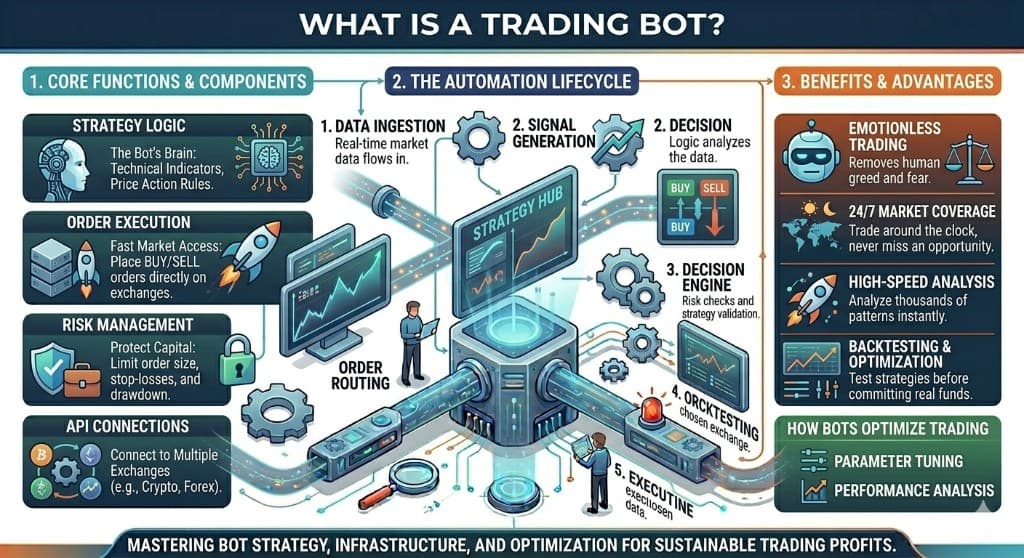
What Is a Trading Bot?
A trading bot is a software program that automatically executes trades based on predefined rules and market conditions.
Instead of manually monitoring charts and placing trades yourself, a trading bot analyzes market data and makes trading decisions according to its programmed strategy.
Trading bots can operate in various markets, including:
- Stock markets
- Forex markets
- Cryptocurrency exchanges
- Futures markets
- Index markets such as the Dow Jones (US30)
The primary goal of a trading bot is to execute a trading strategy consistently without being influenced by emotions such as fear or greed.
How Do Trading Bots Work?
A trading bot follows a set of predefined instructions.
These instructions may include:
- Entry conditions
- Exit conditions
- Risk management rules
- Position sizing calculations
- Time-based restrictions
- Market volatility filters
For example, a trading bot might be programmed to:
- Monitor the Dow Jones Index.
- Detect specific market conditions.
- Place a buy order when criteria are met.
- Set a take-profit target.
- Close the trade automatically.
All of this can happen within seconds without any manual intervention. For a deeper technical breakdown, see how trading bots work.
Why Do Traders Use Trading Bots?
Many traders use automated trading systems because humans are often their own biggest obstacle.
Common trading mistakes include:
- Overtrading
- Fear of missing out (FOMO)
- Moving stop losses
- Closing winning trades too early
- Ignoring risk management rules
A properly designed trading bot follows its strategy exactly as programmed, every time.
Key Benefits of Trading Bots
Consistency
A trading bot executes the same strategy repeatedly without emotional interference.
Speed
Bots can react to market conditions in milliseconds, often much faster than human traders.
Time Efficiency
Many automated systems only require a few minutes of monitoring per day.
Discipline
Bots never become tired, distracted, or emotional.
Are Trading Bots Profitable?
The simple answer is: some are, and some are not.
A trading bot is only as good as the strategy behind it.
Many trading bots fail because they are:
- Poorly designed
- Over-optimized to historical data
- Using excessive leverage
- Based on unrealistic assumptions
Professional trading systems focus on:
- Robust risk management
- Consistent execution
- Realistic expectations
- Long-term performance
Rather than seeking huge returns, successful automated traders often focus on preserving capital and generating steady growth over time. A strong backtest is not a promise, either — understand the gap in backtest vs live trading.
What Are the Risks of Trading Bots?
While trading bots offer many advantages, they are not risk-free.
Potential risks include:
Market Risk
Financial markets can move unexpectedly due to economic events, geopolitical developments, or periods of extreme volatility.
Technical Failures
Internet outages, VPS failures, broker connectivity issues, or software bugs can affect performance.
Slippage
Orders may be executed at different prices than expected during periods of low liquidity or high volatility. Learn more in what is slippage — it is also a key reason identical bots produce different results.
Strategy Failure
No trading strategy works in all market conditions.
This is why risk management — and controlling drawdown — is often more important than the entry signal itself.
Do Trading Bots Need a VPS?
Many professional traders run their bots on a Virtual Private Server (VPS).
A VPS provides:
- 24/7 operation
- Stable internet connectivity
- Reduced latency
- Protection from local power outages
For strategies that rely on fast execution, server location can significantly impact performance. See VPS for trading explained.
Are Trading Bots Legal?
In most countries, trading bots are completely legal.
Banks, hedge funds, proprietary trading firms, and institutional investors use automated trading systems every day.
However, traders should always ensure they comply with:
- Local regulations
- Broker terms and conditions
- Exchange rules
The legality of a trading bot typically depends on how it is used rather than the software itself.
How Can You Evaluate a Trading Bot?
Before using any automated trading system, consider the following:
Live Performance
Does the provider publish verified live results?
Transparency
Can you see historical performance data?
Risk Management
How does the system control losses and drawdowns?
Longevity
How long has the strategy been operating in live market conditions?
Independent Verification
Services such as Myfxbook can provide additional transparency for trading performance. See our guide on how to verify trading results for a full checklist.
The Future of Automated Trading
As technology continues to evolve, trading bots are becoming more sophisticated.
Artificial intelligence, machine learning, and advanced data analysis are helping traders identify opportunities more efficiently than ever before.
However, even the most advanced technology cannot eliminate market risk entirely.
Successful automated trading still relies on sound strategy design, disciplined risk management, and realistic expectations.
Final Thoughts
Trading bots are powerful tools that can help traders automate their strategies and remove emotional decision-making from the trading process.
While they offer advantages such as speed, consistency, and efficiency, they are not guaranteed to generate profits and should always be used with proper risk management.
The most successful trading bots focus on long-term consistency rather than chasing unrealistic returns.
If you’re considering automated trading, take the time to understand how trading bots work, how they manage risk, and how their performance is verified before committing real capital. For a worked example of a transparent, verified system, read the MaxAi Trader review.
Frequently Asked Questions
What is a trading bot?
A trading bot is software that automatically executes trades according to predefined rules. It can analyze markets, open and close positions, and manage risk without constant manual intervention.
How does a trading bot work?
A trading bot continuously monitors the market, checks whether its predefined conditions are met, and then executes orders automatically — applying stop losses, take profits, and position sizing as programmed.
Do trading bots really work?
Trading bots reliably execute the strategy they are given. Whether they are profitable depends on the quality of that strategy, risk management, execution, and market conditions — not the software alone.
Are trading bots safe?
Trading bots are tools and carry the same market risk as any trading. They do not eliminate risk, and safety depends on sound strategy design, risk controls, and realistic expectations.
Can trading bots run automatically 24/7?
Yes, when connected to the market — usually via a VPS that keeps the platform running continuously. This allows the bot to operate around the clock without a home computer staying on.
Essential reading
Educational
Recommended

Important Disclaimer
This site publishes educational research and reviews of automated trading platforms. Content is for educational purposes only.
Nothing on this website is financial advice. Trading involves risk, and performance varies by market conditions, strategy, and user decisions.