
Broker Execution
What Is Slippage in Trading?
Why Your Trade Wasn’t Executed at the Price You Expected
Many traders assume that when they place an order, it will be executed at the exact price shown on their screen.
In reality, that isn’t always what happens.
One of the most important—and often misunderstood—concepts in trading is slippage.
Slippage can have a significant impact on trading performance, especially for automated trading systems, high-frequency strategies, and traders operating during volatile market conditions.
In this guide, we’ll explain what slippage is, why it happens, and how traders can reduce its impact.
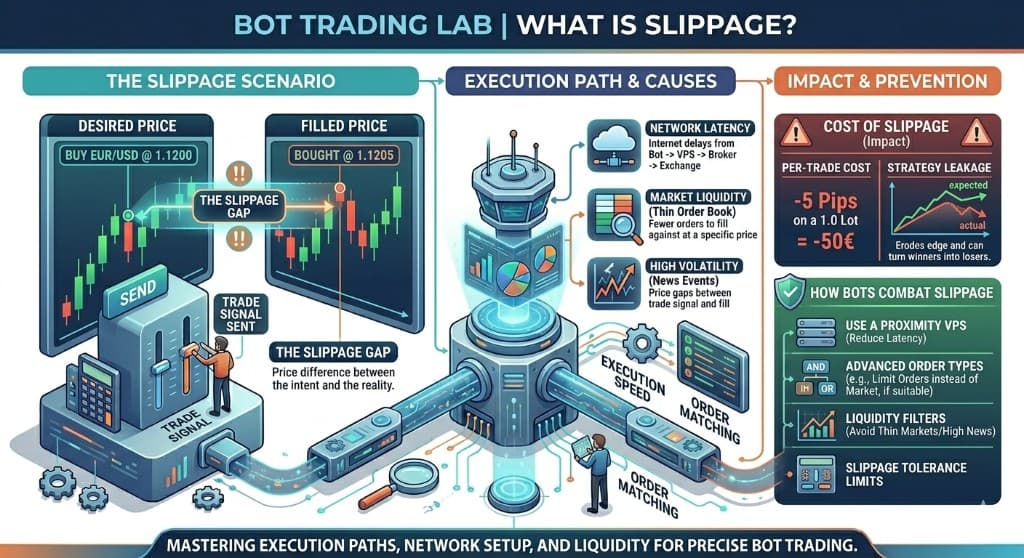
What Is Slippage?
Slippage occurs when an order is executed at a different price than the price requested.
For example:
You submit a buy order at 40,000, but the actual execution occurs at 40,002.
The difference of 2 points is called slippage.
Slippage can occur on:
- Market orders
- Stop orders
- Pending orders
- Automated trading systems
- Manual trades
It is a normal part of financial markets and affects both retail and institutional traders.
Positive vs Negative Slippage
Most traders focus only on negative slippage, but slippage can occur in both directions.
Positive Slippage
Positive slippage occurs when the trade is executed at a better price than requested.
Example: requested buy price 40,000, actual execution 39,998. You received a more favorable entry price.
Negative Slippage
Negative slippage occurs when the trade is executed at a worse price than requested.
Example: requested buy price 40,000, actual execution 40,003. You entered at a less favorable price.
Over time, both forms of slippage may occur, although some strategies are more sensitive to negative slippage than others.
Why Does Slippage Happen?
Slippage occurs because financial markets are constantly moving.
Prices can change between:
- The moment an order is submitted.
- The moment the order reaches the broker.
- The moment the broker routes the order.
- The moment liquidity becomes available.
Even delays measured in milliseconds can influence execution prices. The full order journey is covered in market execution explained.
The Role of Market Liquidity
Liquidity refers to the amount of available buying and selling interest in the market.
High liquidity generally leads to:
- Better execution
- Smaller slippage
- Tighter spreads
Low liquidity often leads to:
- Larger slippage
- Wider spreads
- Greater execution uncertainty
This is why execution quality often changes during different times of the trading day. Read more in how liquidity affects trading performance.
Market Depth Explained
Most traders only see the best available bid and ask price.
However, behind those prices sits a deeper order book.
Imagine the following simplified example:
| Price | Available Volume |
|---|---|
| 40,000 | 1 contract |
| 40,001 | 2 contracts |
| 40,002 | 5 contracts |
| 40,003 | 10 contracts |
If a trader attempts to buy 8 contracts, the order may need to be filled across multiple price levels.
The result is slippage.
This process occurs continuously in all financial markets.
Why Larger Orders Often Experience More Slippage
Larger orders typically consume more available liquidity.
As order size increases, the market may need to access multiple liquidity levels to complete the trade.
This means:
- Small orders often receive better fills.
- Larger orders may experience greater slippage.
Institutional traders spend significant resources optimizing execution quality for precisely this reason — see why bigger trading accounts sometimes get worse execution.
Slippage and Trading Bots
Automated trading systems are often highly sensitive to execution quality.
Consider a strategy targeting:
- 10 points profit
- Average trade duration of 5 minutes
If slippage adds:
- 2 points at entry
- 2 points at exit
The strategy loses 40% of its expected profit before market movement is even considered.
This is why execution quality is often one of the most important factors in automated trading performance.
Why Identical Bots Can Produce Different Results
One of the most surprising discoveries for many traders is that identical trading bots can generate different results.
Even when:
- The same strategy is used
- The same settings are applied
- Trades occur at the same time
Results may differ due to:
Broker Liquidity
Different brokers access different liquidity providers.
Server Location
Execution speed varies depending on distance from trading servers.
Market Depth
Available liquidity can change from one broker to another.
Slippage
Small execution differences accumulate over hundreds or thousands of trades.
Over time, these differences can become significant. We cover this in detail in why identical trading bots produce different results.
When Slippage Is Most Common
Slippage tends to increase during periods of:
Major Economic News
Examples include:
- Interest rate decisions
- Inflation reports
- Employment data
Market Openings
Market openings often create sudden increases in volatility.
Low Liquidity Periods
Examples include:
- Holidays
- Overnight sessions
- Weekend openings
Unexpected Events
Geopolitical developments and breaking news can create substantial execution challenges.
Can Slippage Be Eliminated?
No.
Slippage is a natural consequence of real financial markets.
Even large banks and hedge funds experience slippage.
The goal is not to eliminate it completely but to minimize its impact.
How Traders Can Reduce Slippage
Use a Reliable Broker
Execution quality varies significantly between brokers.
Trade Liquid Markets
Highly liquid markets generally provide better execution.
Avoid High-Impact News Events
Many traders reduce exposure around major economic announcements.
Use a VPS
Running automated systems on a VPS can reduce latency and improve execution consistency.
Monitor Execution Statistics
Professional traders regularly review:
- Average slippage
- Fill quality
- Trade execution times
These metrics can reveal hidden performance issues.
Why Slippage Matters More Than Many Traders Realize
Many traders focus heavily on:
- Win rate
- Indicators
- Entry signals
Yet execution quality can have an equal or greater impact on long-term performance.
A strategy with excellent execution may outperform a theoretically superior strategy suffering from poor execution.
For short-term automated systems, slippage often becomes one of the most important performance variables. It also explains why backtest and live trading results differ.
Common Myths About Slippage
Myth 1: Slippage Means a Broker Is Manipulating Prices
Not necessarily.
Most slippage is a normal consequence of changing market conditions and available liquidity.
Myth 2: Slippage Only Happens During News
Slippage can occur at any time, although it often increases during volatile periods.
Myth 3: Fast Internet Eliminates Slippage
Execution speed helps, but liquidity and market conditions remain the primary drivers.
Myth 4: Small Differences Don’t Matter
Across hundreds or thousands of trades, even small execution differences can have a substantial impact on overall profitability.
Final Thoughts
Slippage is the difference between the expected execution price and the actual execution price of a trade.
While it is a normal feature of financial markets, its impact can be significant—particularly for automated trading systems and short-term strategies.
Understanding how slippage works allows traders to make better decisions about:
- Broker selection
- VPS infrastructure
- Risk management
- Strategy design
In many cases, improving execution quality can have a greater effect on long-term trading performance than changing the trading strategy itself.
Frequently Asked Questions
What is slippage?
Slippage is the difference between the price a trader expects when placing an order and the price at which the order is actually filled. It can be positive or negative and is a normal part of live trading.
What causes slippage?
Slippage is usually caused by fast-moving markets, changes in liquidity, wide spreads, execution delays, and orders competing for the available volume at a given price level.
Is slippage always bad?
No. Slippage can be negative (a worse price) or positive (a better price). Some brokers pass on positive slippage. The goal is consistent, fair execution rather than eliminating slippage entirely.
Can a VPS reduce slippage?
A VPS cannot remove market-driven slippage, but by lowering latency between the trading platform and the broker it can reduce delays that contribute to slippage, helping orders reach the market faster and more consistently.
How does slippage affect trading bots?
Slippage is especially important for short-term and scalping bots that target small gains. A few points of slippage per trade can significantly erode expected profit over hundreds of trades.
How can traders reduce slippage?
Trading during liquid sessions, choosing brokers with strong execution and deep liquidity, using a low-latency VPS near the broker, and avoiding major news spikes can all help reduce slippage.
Essential reading
Educational
Recommended

Important Disclaimer
This site publishes educational research and reviews of automated trading platforms. Content is for educational purposes only.
Nothing on this website is financial advice. Trading involves risk, and performance varies by market conditions, strategy, and user decisions.