
Broker Execution
How Liquidity Affects Trading Performance
The Hidden Force Behind Every Trade
Most traders spend their time focusing on charts, indicators, trading strategies, and market analysis.
However, one of the most important factors affecting trading performance is often invisible:
Liquidity.
Liquidity influences:
- Trade execution
- Slippage
- Spreads
- Volatility
- Profitability
In many cases, two traders using the same strategy can achieve different results simply because of differences in liquidity.
Understanding liquidity is essential for anyone involved in manual trading, automated trading, Expert Advisors, or trading bots.
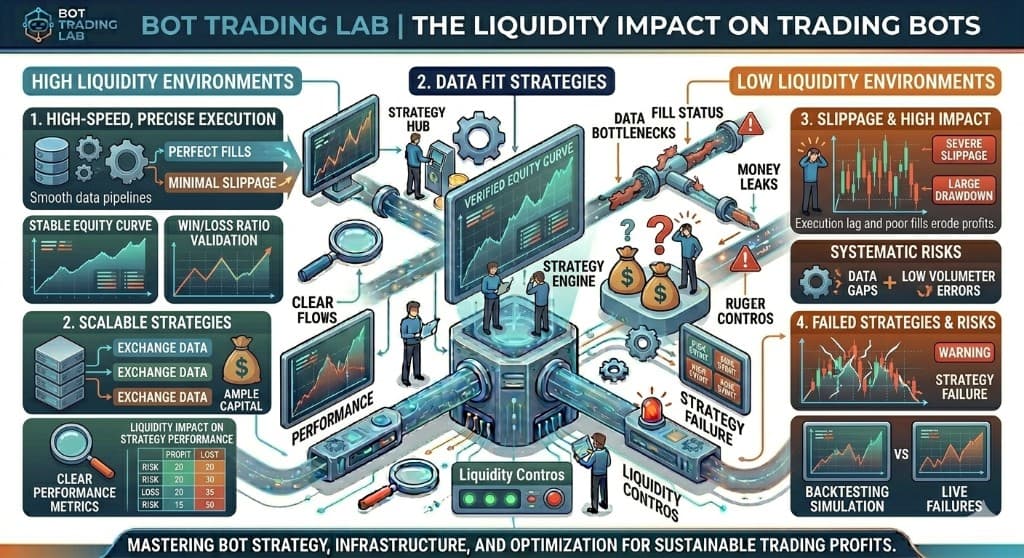
What Is Liquidity?
Liquidity refers to how easily an asset can be bought or sold without significantly affecting its market price.
A market is considered highly liquid when:
- Many buyers exist
- Many sellers exist
- Large orders can be executed quickly
- Price movement remains relatively stable
A market is considered less liquid when:
- Fewer participants are active
- Available volume is limited
- Large orders move prices more easily
Liquidity exists in every financial market, including:
- Stocks
- Forex
- Futures
- Indices
- Cryptocurrencies
Why Liquidity Matters
Every trade requires a buyer and a seller.
Without sufficient liquidity:
- Execution becomes more difficult
- Slippage increases
- Spreads widen
- Volatility rises
Many traders focus on identifying profitable trade setups.
However, even the best trading signal must still be executed within a real market environment.
Liquidity determines how efficiently that execution occurs — a core part of market execution.
Understanding Market Depth
Most traders only see the best available bid and ask prices.
Behind those prices sits an entire order book containing multiple layers of liquidity.
For example:
| Price | Available Volume |
|---|---|
| 40,000 | 2 contracts |
| 40,001 | 5 contracts |
| 40,002 | 10 contracts |
| 40,003 | 20 contracts |
When an order enters the market, it consumes available volume.
If insufficient liquidity exists at the first level, the order may continue filling at higher or lower prices.
This process directly affects execution quality.
Liquidity and Slippage
One of the most visible consequences of liquidity is slippage.
Imagine a trader places an order expecting execution at 40,000.
However, available liquidity is insufficient.
The order ultimately executes at 40,003.
The difference represents slippage.
Low liquidity often increases the likelihood of execution at less favorable prices.
For short-term strategies, even small amounts of slippage can significantly affect profitability.
Why Liquidity Changes Throughout the Day
Liquidity is not constant.
It changes continuously based on market participation.
Typically, liquidity increases during:
- Major market openings
- Overlapping trading sessions
- High-volume periods
Liquidity often decreases during:
- Holidays
- Overnight sessions
- Market transitions
- Periods of uncertainty
This is why the same strategy may behave differently depending on the time of day.
Why Market Openings Matter
Some of the highest liquidity levels occur around major market opens.
Examples include:
London Open
A significant increase in Forex liquidity.
New York Open
Heavy participation across Forex, indices, and futures markets.
These periods often provide:
- Tighter spreads
- Better execution
- Higher trading volume
However, they may also generate increased volatility.
The Relationship Between Liquidity and Volatility
Liquidity and volatility are closely connected.
High liquidity generally helps absorb buying and selling pressure.
Low liquidity makes markets more sensitive to incoming orders.
This is why unexpected events can create dramatic price movements when liquidity is limited.
In thin markets, relatively small orders can sometimes produce surprisingly large price changes.
Why Larger Orders Face More Challenges
Many traders assume execution quality remains constant regardless of position size.
In reality, larger orders often face additional challenges.
A small order may be filled entirely at one price.
A larger order may need to access multiple levels of market liquidity before completion.
This can result in:
- Increased slippage
- Worse average execution
- Greater execution variability
Institutional traders devote significant resources to managing this challenge — see why bigger accounts sometimes perform worse.
Why Identical Trading Bots Can Produce Different Results
Liquidity helps explain one of the most common mysteries in automated trading.
Two identical trading bots may:
- Use the same strategy
- Receive the same signal
- Trade at the same time
Yet produce different outcomes.
Why?
Because execution depends on:
- Available liquidity
- Market depth
- Broker routing
- Order timing
Even small differences can accumulate over hundreds or thousands of trades. We cover this in why identical trading bots produce different results.
Liquidity and Automated Trading
Automated trading systems are often especially sensitive to liquidity conditions.
Many trading bots rely on:
- Fast execution
- Small profit targets
- Consistent fills
When liquidity decreases:
- Slippage increases
- Trade costs rise
- Performance may deteriorate
For this reason, professional automated traders often pay close attention to execution quality and market conditions.
Why Brokers Matter
Different brokers may access different liquidity sources.
As a result:
- Spreads may differ
- Slippage may differ
- Execution quality may differ
Even when traders use the same strategy, broker infrastructure can influence results.
This explains why performance sometimes varies across brokers despite identical trading systems — and why the right broker setup matters.
How Liquidity Affects Spreads
The spread represents the difference between:
- The highest bid price
- The lowest ask price
High liquidity generally produces:
- Tighter spreads
Low liquidity often produces:
- Wider spreads
Wider spreads increase trading costs and can reduce profitability, particularly for short-term strategies.
Common Situations That Reduce Liquidity
Liquidity often declines during:
Major Economic News
Market participants may temporarily withdraw liquidity due to uncertainty.
Holidays
Lower participation often reduces available volume.
Market Closures
Transitions between sessions can temporarily reduce activity.
Geopolitical Events
Unexpected developments can create uncertainty and lower liquidity.
Understanding these periods can help traders manage risk more effectively.
How Traders Can Adapt
While traders cannot control liquidity, they can adjust their approach.
Common techniques include:
Trading During Active Sessions
Higher participation generally improves execution quality.
Monitoring Spreads
Widening spreads often indicate declining liquidity.
Using Reliable Infrastructure
Stable connections and low-latency environments can improve execution consistency — see VPS for trading.
Managing Position Size
Larger orders may require greater attention to execution quality.
Common Liquidity Myths
Myth 1: Liquidity Only Matters for Large Institutions
Liquidity affects traders of all sizes.
Myth 2: Price Charts Show Everything
Charts show price movement but not always the underlying market depth.
Myth 3: Liquidity Is Constant
Liquidity changes continuously throughout the trading day.
Myth 4: Slippage Means Something Is Wrong
Slippage is often a natural consequence of changing liquidity conditions.
Why Professional Traders Monitor Liquidity
Experienced traders understand that execution quality can influence performance just as much as strategy design.
They routinely monitor:
- Market depth
- Spread behaviour
- Liquidity conditions
- Execution quality
This allows them to better understand how their strategies interact with real market conditions.
Final Thoughts
Liquidity is one of the most important forces in financial markets.
It affects:
- Execution quality
- Slippage
- Spreads
- Volatility
- Overall trading performance
While many traders focus exclusively on trading signals, successful trading also requires understanding how those signals are executed within the market.
Whether you’re trading manually or using automated systems, liquidity plays a critical role in determining real-world results.
The strongest strategies are not only designed to identify opportunities—they are also designed to operate effectively within the realities of market liquidity.
Frequently Asked Questions
What is liquidity in trading?
Liquidity refers to how much buying and selling interest is available in a market at any given time. High liquidity means orders can be filled quickly at stable prices; low liquidity means fills can be slower and prices less stable.
How does liquidity affect trading bots?
Trading bots rely on consistent execution. In liquid conditions orders fill smoothly at expected prices, while in low-liquidity conditions bots can experience wider spreads, more slippage, and less predictable fills.
When is liquidity lowest?
Liquidity is typically lowest outside main trading sessions, around market opens and closes, during holidays, and immediately before or after major economic announcements.
Why does low liquidity increase slippage?
When there is little volume available at the best price, larger orders must consume liquidity across multiple price levels, resulting in a worse average fill — which is experienced as slippage.
Can larger accounts be affected by liquidity more than smaller ones?
Yes. Larger positions consume more of the available liquidity, so they are more likely to experience worse average fills and increased slippage, particularly during low-liquidity periods.
Can traders improve execution by managing liquidity?
Trading during the most liquid sessions, choosing brokers with deep liquidity access, and being mindful of position size relative to market depth can all improve execution quality.
Essential reading
Educational
Recommended

Important Disclaimer
This site publishes educational research and reviews of automated trading platforms. Content is for educational purposes only.
Nothing on this website is financial advice. Trading involves risk, and performance varies by market conditions, strategy, and user decisions.