
Broker Execution
Market Execution Explained: What Happens After You Click Buy?
Understanding the Journey of a Trade Order
Most traders spend their time analyzing charts, searching for trading opportunities, and developing strategies.
But very few understand what actually happens after they click:
Buy
or
Sell
The process may appear instantaneous, but behind the scenes, several systems, servers, and liquidity sources work together to execute every trade.
Understanding this process can help traders better understand:
- Slippage
- Execution quality
- Liquidity
- Broker performance
- Trading bot behaviour
In this guide, we’ll walk through the entire execution process from the moment an order is submitted until it is filled.
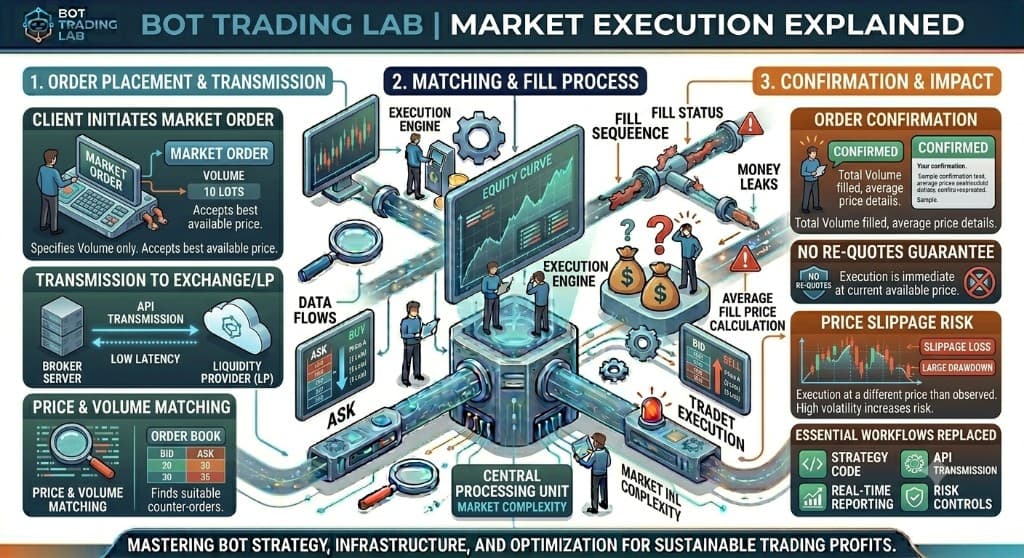
Step 1: The Trading Signal
Every trade begins with a decision.
This decision may come from:
- A manual trader
- A trading bot
- An Expert Advisor
- A signal service
- A copy trading system
Once the decision is made, an order is generated.
Examples include:
- Buy Market
- Sell Market
- Buy Stop
- Sell Stop
- Buy Limit
- Sell Limit
The order is then transmitted to the broker.
Step 2: The Order Leaves Your Platform
When you click Buy or Sell, the trading platform sends the order to the broker’s trading server.
This communication occurs through the internet.
The speed depends on factors such as:
- Internet quality
- VPS location
- Network latency
- Server load
Although this process often takes milliseconds, every delay contributes to total execution time — see why trading bots need low latency.
Step 3: The Broker Receives the Order
Once the broker receives the order, it must determine how to process it.
The broker’s infrastructure evaluates:
- Instrument
- Order size
- Account type
- Available liquidity
- Market conditions
At this point, the broker begins searching for available execution opportunities.
Step 4: The Broker Searches for Liquidity
This is where many traders misunderstand the process.
A broker cannot simply invent a price.
The order must be matched with available liquidity.
Liquidity may come from:
- Banks
- Financial institutions
- Market makers
- Exchanges
- Liquidity providers
The broker’s system searches for the best available execution based on current market conditions. Learn how liquidity affects trading performance.
What Is a Liquidity Provider?
A liquidity provider is an institution willing to buy or sell a financial instrument.
Examples include:
- Major banks
- Prime brokers
- Market makers
- Institutional trading firms
These participants provide the market depth that makes trading possible.
Without liquidity providers, markets could not function efficiently.
Step 5: The Order Meets the Order Book
Every market contains an order book.
The order book contains multiple price levels with different amounts of available volume.
For example:
| Price | Available Volume |
|---|---|
| 40,000 | 2 contracts |
| 40,001 | 5 contracts |
| 40,002 | 8 contracts |
| 40,003 | 20 contracts |
The broker attempts to fill the order using available liquidity.
If sufficient volume exists at the first level, execution is straightforward.
If not, the order may need to access multiple levels.
Why Slippage Happens
Imagine you submit a buy order at 40,000.
However, before the order reaches the market:
- Other traders buy available liquidity
- Prices move higher
- Market conditions change
The available price becomes 40,002.
The trade executes at the next available level.
This difference is called slippage.
Slippage is a normal feature of live markets and occurs because execution takes place within a constantly changing environment.
Why Two Traders Can Get Different Prices
This surprises many traders.
Two traders may:
- Use the same broker
- Trade the same instrument
- Place the same order
Yet receive different execution prices.
Possible reasons include:
- Different order timing
- Different account servers
- Different latency
- Different available liquidity
Even tiny timing differences measured in milliseconds can affect outcomes — explored in why identical trading bots produce different results.
Step 6: The Trade Is Confirmed
Once liquidity has been located and execution completed, the broker sends a confirmation back to the trading platform.
The trader sees:
- Entry price
- Position size
- Trade status
At this point, the trade becomes active.
Why Market Conditions Matter
Execution quality varies significantly depending on market conditions.
High Liquidity Conditions
Often provide:
- Faster execution
- Smaller slippage
- Tighter spreads
Low Liquidity Conditions
Often produce:
- Larger slippage
- Wider spreads
- Increased execution variability
This is one reason why the same strategy may perform differently during different times of the day.
The Impact of Market Openings
Major market openings often create unique execution environments.
Examples include:
London Open
High Forex participation.
New York Open
Significant activity in:
- Forex
- Futures
- Indices
- Equities
These periods may offer strong liquidity but also increased volatility.
How VPS Hosting Influences Execution
For automated trading systems, infrastructure matters.
A VPS located near the broker’s server may reduce communication delays.
Lower latency can help:
- Improve execution consistency
- Reduce transmission delays
- Support automated trading systems
While a VPS cannot eliminate slippage, it can improve the speed at which orders reach the broker — see VPS for trading.
Why Larger Orders Can Receive Worse Prices
Order size plays an important role.
A small order may be filled entirely at one price.
A larger order may require multiple liquidity levels.
Example:
Small order: filled at 40,000
Large order: partially filled at:
- 40,000
- 40,001
- 40,002
The average execution price becomes less favorable.
This phenomenon affects both retail and institutional traders — see why bigger accounts sometimes perform worse.
Why Execution Quality Matters
Many traders focus exclusively on:
- Indicators
- Win rates
- Strategy design
However, execution quality can significantly influence profitability.
Particularly for:
- Trading bots
- Scalping systems
- Short-term strategies
Even small execution differences can accumulate over hundreds or thousands of trades.
Common Market Execution Myths
Myth 1: Orders Execute Instantly
Execution requires communication, matching, and liquidity.
Myth 2: Brokers Control Every Price
Prices are heavily influenced by available market liquidity.
Myth 3: Slippage Means Something Is Wrong
Slippage is a natural feature of financial markets.
Myth 4: Execution Does Not Affect Performance
Execution quality can significantly impact trading outcomes.
What Professional Traders Monitor
Professional traders often track:
- Execution speed
- Slippage statistics
- Fill quality
- Spread behaviour
- Liquidity conditions
These metrics help determine whether a strategy is performing as expected.
Final Thoughts
Every trade follows a journey.
After you click Buy or Sell, your order must travel through:
- Trading platforms
- Network infrastructure
- Broker systems
- Liquidity providers
- Market order books
Only then does execution occur.
Understanding this process helps explain many of the phenomena traders encounter, including:
- Slippage
- Different execution prices
- Liquidity challenges
- Broker performance differences
The strongest trading strategies are not only built around market analysis.
They also account for the realities of market execution.
Because in live trading, identifying a good opportunity is only part of the equation.
Successfully executing that opportunity is equally important.
Frequently Asked Questions
What is market execution?
Market execution means an order is filled at the best available price when it reaches the broker, rather than at a fixed requested price. The exact fill price may differ slightly from the price shown when the order was sent.
What happens after you click buy?
The order travels from your platform to the broker, is matched against available liquidity, and is filled at the best available price. The confirmed fill then returns to your platform — all within milliseconds.
What is the difference between market and instant execution?
Market execution fills at the best available price with no requotes, while instant execution attempts to fill at a specific requested price and may issue a requote if that price is no longer available.
Why do orders sometimes fill at a different price?
Prices move continuously, and there is a small delay between sending an order and it being filled. If the market moves or liquidity shifts in that time, the fill price can differ — this is slippage.
What is a requote?
A requote happens when the requested price is no longer available and the broker offers a new price instead. Market execution avoids requotes, which is why it is generally preferred for automated trading.
Essential reading
Educational
Recommended

Important Disclaimer
This site publishes educational research and reviews of automated trading platforms. Content is for educational purposes only.
Nothing on this website is financial advice. Trading involves risk, and performance varies by market conditions, strategy, and user decisions.