
Trading Bots
Questions to Ask Before Buying a Trading Bot
A Smart Investor’s Checklist
The trading bot industry is full of bold claims.
You’ll often see promises such as:
- Automated profits
- Passive income
- High win rates
- Consistent monthly returns
While some trading bots are built around robust strategies and sound risk management, others rely more on marketing than substance.
Before investing your money, it’s important to ask the right questions.
The answers will often tell you far more about a trading bot than any performance chart or sales page.
In this guide, we’ll cover the most important questions every trader should ask before buying a trading bot. It pairs well with our guide on how to choose a trading bot.
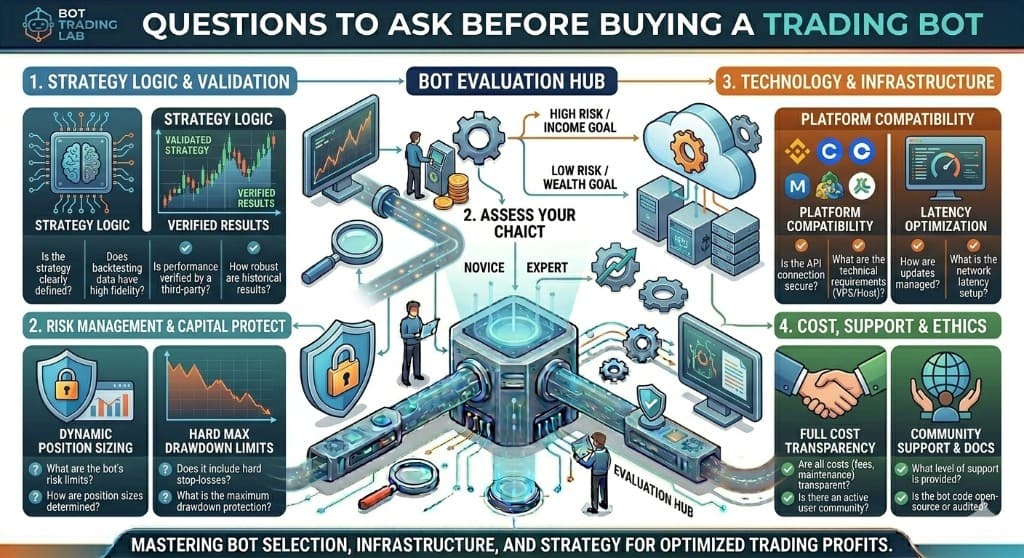
Question 1: Is There Verified Live Performance?
This should always be your starting point.
Many providers show:
- Backtests
- Screenshots
- Hypothetical returns
While these can be informative, they are not substitutes for live performance.
Ask:
Can the results be independently verified?
Look for:
- Live trading accounts
- Public performance records
- Third-party verification platforms
- Long-term live results
Transparency is often a strong indicator of credibility. Learn how to verify trading results.
Question 2: What Is the Maximum Drawdown?
Many traders focus on returns.
Professional investors focus on risk.
Ask:
What is the largest historical drawdown?
Drawdown reveals how much the account has declined from a previous peak.
Understanding drawdown helps answer an important question:
How much risk was taken to achieve those returns?
Question 3: How Long Has the Strategy Been Running Live?
A strong month proves very little.
A strong year provides more insight.
Several years of live performance often provide much greater confidence.
Ask:
How long has the strategy been operating in real market conditions?
Longer track records help reveal how the strategy behaves during:
- Volatile markets
- Economic uncertainty
- Market corrections
- Different trading environments
Question 4: How Is Risk Managed?
Every legitimate strategy experiences losses.
What matters is how those losses are controlled.
Ask:
- How is position size determined?
- Are there exposure limits?
- Is leverage used?
- Are there drawdown controls?
Risk management often determines whether a strategy survives difficult periods.
Question 5: Does the Bot Use Grid Trading?
Many traders do not ask this question.
They should.
Some trading bots rely on:
- Grid trading
- Averaging into losses
- Recovery systems
These approaches can produce attractive short-term results but may increase risk during strong market trends — see why we don’t use grid trading.
Understanding how the strategy handles losing trades is essential.
Question 6: What Market Does the Bot Trade?
Different trading bots focus on different markets.
Examples include:
Forex
Currency trading — see forex trading bots.
Indices
Markets such as:
- Dow Jones
- NASDAQ
- S&P 500
Stocks
Individual companies.
Cryptocurrency
Digital assets.
The market being traded influences:
- Volatility
- Liquidity
- Trading opportunities
- Risk characteristics
Question 7: How Often Does the Bot Trade?
Trade frequency can influence:
- Trading costs
- Slippage
- Performance consistency
Ask:
How many trades are typically placed per month?
Understanding trade frequency helps set realistic expectations.
Question 8: What Broker Setup Is Recommended?
Execution quality matters.
Ask:
- Which brokers are supported?
- Is VPS hosting recommended?
- What platform is required?
- MT4 or MT5?
A strong strategy can still be affected by poor execution infrastructure — see best broker setup for trading bots.
Question 9: Are There Additional Costs?
The purchase price may not be the only expense.
Potential costs include:
- VPS hosting
- Software subscriptions
- Broker commissions
- Trading spreads
Understanding total costs provides a more accurate picture of expected performance.
Question 10: What Happens During Volatile Markets?
Every strategy performs differently under stress.
Ask:
How did the system behave during major market events?
Examples include:
- Market crashes
- High-volatility periods
- Economic shocks
The answer often reveals the strength of the risk management framework.
Question 11: Can I See Real Trade History?
Performance summaries are useful.
Detailed trade history can provide additional insight.
Look for evidence of:
- Consistency
- Risk control
- Realistic execution
The more transparent the provider, the easier it becomes to evaluate the strategy objectively.
Question 12: What Are the Expected Returns?
Be cautious when evaluating return expectations.
Ask:
What is considered a realistic return range?
Providers discussing:
- Risk
- Drawdown
- Uncertainty
often inspire more confidence than those promising extraordinary profits.
Question 13: What Happens During Losing Periods?
Every strategy experiences underperformance.
Ask:
- How often do losing months occur?
- How are drawdowns handled?
- What should investors expect during difficult periods?
Realistic discussions about losses are usually a positive sign.
Question 14: Is Customer Support Available?
Even the best trading systems occasionally require assistance.
Consider:
- Installation support
- Technical support
- Setup guidance
- Ongoing communication
Strong support can significantly improve the user experience.
Question 15: Would a Professional Investor Ask the Same Questions?
This is perhaps the most useful question of all.
Professional investors typically focus on:
- Risk
- Transparency
- Verification
- Consistency
- Longevity
If a provider struggles to answer these questions clearly, caution may be warranted.
Warning Signs to Watch For
Be careful if you encounter:
Guaranteed Profits
No strategy can guarantee future returns.
No Discussion of Risk
Every legitimate strategy carries risk.
Excessive Focus on Win Rate
Win rate alone reveals very little.
No Live Verification
Claims should be supported by evidence.
Unrealistic Return Claims
Extraordinary promises often deserve extra scrutiny.
A Simple Trading Bot Evaluation Checklist
Before purchasing any trading bot, ask:
- ✓ Is performance verified?
- ✓ Is drawdown clearly disclosed?
- ✓ Is risk management explained?
- ✓ Is the track record long enough?
- ✓ Are expectations realistic?
- ✓ Is the provider transparent?
- ✓ Are costs clearly explained?
- ✓ Is support available?
The more “yes” answers you receive, the more confidence you can have in your evaluation process.
Common Myths About Buying Trading Bots
Myth 1: High Returns Mean a Better Bot
Risk-adjusted performance matters more.
Myth 2: Backtests Prove Future Success
Live performance is more important.
Myth 3: Automation Eliminates Risk
All trading involves risk.
Myth 4: More Trades Mean Better Results
Quality matters more than quantity.
Final Thoughts
Buying a trading bot should be approached the same way you would evaluate any investment.
Rather than focusing solely on profit potential, ask questions about:
- Risk management
- Drawdown
- Transparency
- Verification
- Long-term consistency
The strongest trading bots are rarely the ones making the biggest promises.
They are usually the ones that provide honest answers, realistic expectations, and a proven approach to managing risk.
In automated trading, asking the right questions often matters more than finding the right sales page.
Frequently Asked Questions
What questions should you ask before buying a trading bot?
Ask whether performance is verified, what the maximum drawdown is, how long it has run live, how risk is managed, whether it uses grid trading, what market it trades, and how it behaves in volatile conditions.
Why is verified live performance important?
Anyone can publish backtests or screenshots. Verified live results from independent tracking show how a strategy actually performs in real market conditions, making them far more reliable evidence.
What are warning signs of a poor trading bot?
Guaranteed profits, no discussion of risk, excessive focus on win rate, no live verification, and unrealistic return claims are all red flags worth extra scrutiny.
Should I ask about additional costs?
Yes. The purchase price may not be the only expense. VPS hosting, software subscriptions, broker commissions, and spreads all affect your true net performance.
What should I ask about losing periods?
Ask how often losing months occur, how drawdowns are handled, and what to expect during difficult periods. Honest, realistic answers about losses are usually a positive sign.
Essential reading
Educational
Recommended

Important Disclaimer
This site publishes educational research and reviews of automated trading platforms. Content is for educational purposes only.
Nothing on this website is financial advice. Trading involves risk, and performance varies by market conditions, strategy, and user decisions.