
Trading Bots
How to Choose a Trading Bot
A Practical Guide for Traders and Investors
The internet is full of trading bots promising:
- Passive income
- High returns
- Automated profits
- Minimal effort
A simple search reveals hundreds of options, each claiming to be better than the last.
The challenge is not finding a trading bot.
The challenge is choosing one that is realistic, transparent, and capable of surviving real market conditions.
In this guide, we’ll explain what traders should look for when evaluating a trading bot and how to avoid some of the most common mistakes. For a closer look at the individual evaluation criteria, see what to look for in a trading bot.
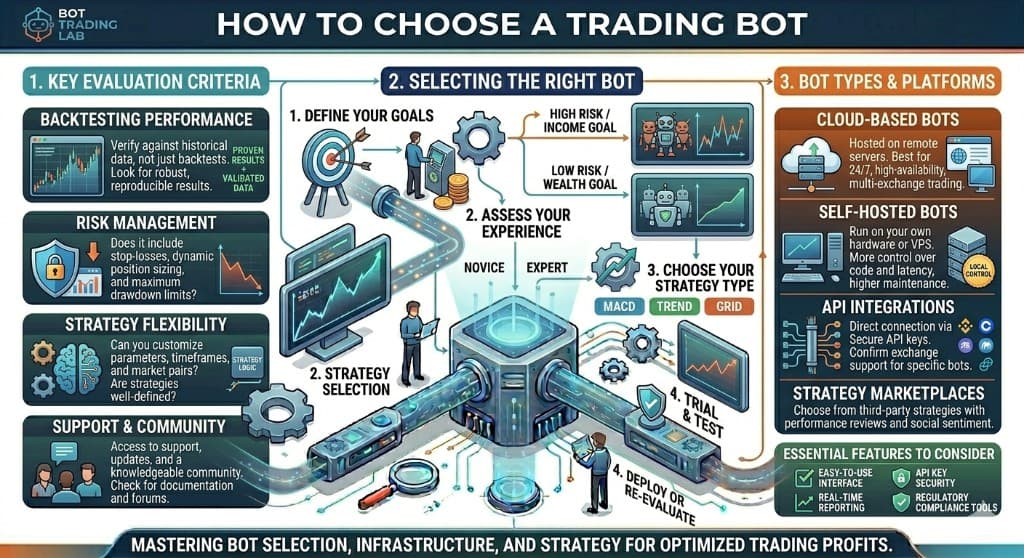
Start With the Right Question
Most people ask:
“Which trading bot makes the most money?”
A better question is:
“Which trading bot manages risk effectively while producing sustainable returns?”
Professional investors rarely focus exclusively on profits.
They focus on:
- Risk
- Drawdown
- Consistency
- Transparency
- Longevity
These factors often determine long-term success.
Look for Verified Live Performance
One of the first things to evaluate is performance verification.
Many providers show:
- Screenshots
- Backtests
- Simulated results
While these may be useful, they are not substitutes for live performance.
Look for:
- Verified live accounts
- Independent tracking
- Public performance records
- Long-term results
Live results provide a much clearer picture of how a strategy performs in real market conditions. Learn how to verify trading results.
Understand the Drawdown
Many traders focus on returns while ignoring risk.
This is a mistake.
Imagine two trading bots:
Bot A
- Annual Return: 20%
- Maximum Drawdown: 8%
Bot B
- Annual Return: 20%
- Maximum Drawdown: 35%
Both generated identical returns.
Most professional investors would choose Bot A because it achieved those returns with significantly less risk.
Drawdown is often one of the most important metrics when evaluating a trading strategy.
Ask How the Strategy Works
You do not need access to proprietary code.
However, you should understand:
- What market is traded
- General strategy philosophy
- Risk management approach
- Typical holding period
If a provider cannot explain the strategy at a high level, that should raise questions.
Transparency matters.
Be Careful With High Win Rates
Many trading bots advertise:
- 90% win rates
- 95% win rates
- 98% win rates
High win rates sound attractive.
However, they can be misleading.
Some strategies generate many small gains while exposing the account to occasional large losses.
Always evaluate:
- Drawdown
- Risk-adjusted returns
- Long-term consistency
rather than focusing solely on win rate.
Check the Length of the Track Record
A trading bot that has performed well for:
- One month
- Three months
- Six months
has not necessarily proven itself.
Longer track records help demonstrate how a strategy behaves during:
- Different market conditions
- Volatile periods
- Economic uncertainty
- Market transitions
The longer the track record, the more confidence investors can have in the data.
Understand Risk Management
Every trading bot should have a clear risk management framework.
Questions worth asking include:
- How is position size determined?
- Are there exposure limits?
- What is the maximum historical drawdown?
- How are losses controlled?
- What happens during extreme market events?
Strong risk management often separates sustainable strategies from short-lived ones.
Does the Bot Use Grid Trading?
This is an important question.
Some trading bots rely heavily on:
- Grid trading
- Averaging into losses
- Recovery systems
These approaches can generate attractive short-term performance.
However, they may also increase risk during strong market trends — see why we don’t use grid trading.
Understanding how a strategy handles losing trades is essential.
Evaluate Transparency
A quality provider should be willing to discuss:
- Risk
- Drawdowns
- Losing periods
- Performance history
Be cautious if the conversation focuses only on profits.
Every legitimate trading strategy experiences losses.
Transparency is often a sign of professionalism.
Consider Execution Quality
Even strong strategies can be affected by:
- Slippage
- Liquidity
- Broker quality
- VPS infrastructure
Execution quality influences real-world performance.
This is particularly important for:
- Scalping systems
- Short-term strategies
- Automated trading bots
Understand the Market Being Traded
Different bots focus on different markets.
Examples include:
Forex Bots
Trading currency pairs — see forex trading bots.
Index Trading Bots
Trading markets such as:
- Dow Jones
- NASDAQ
- S&P 500
Cryptocurrency Bots
Trading digital assets.
Multi-Asset Systems
Trading multiple markets simultaneously.
The market being traded influences both risk and opportunity.
Beware of Unrealistic Claims
Be cautious when you see statements such as:
- Guaranteed profits
- No losing months
- Risk-free trading
- Never loses
Markets involve uncertainty.
No legitimate provider can guarantee future returns.
Realistic expectations are usually a positive sign.
Questions to Ask Before Buying
Before committing to a trading bot, consider asking:
- Is there verified live performance?
- What is the maximum drawdown?
- How long has the strategy operated?
- How is risk managed?
- Does the strategy use grid trading?
- What broker setup is recommended?
- What happens during volatile markets?
The answers often reveal more than any marketing page.
Common Mistakes Traders Make
Choosing Based on Returns Alone
Risk matters just as much as performance.
Ignoring Drawdown
Large drawdowns can be difficult to recover from.
Trusting Screenshots
Verification is more valuable than images.
Chasing the Latest Trend
Consistency often beats excitement.
Focusing on Win Rate
Win rate is only one piece of the puzzle.
What Professional Investors Look For
Professional investors often evaluate:
- Risk-adjusted returns
- Transparency
- Verification
- Longevity
- Consistency
Notice that “highest return” rarely appears at the top of the list.
Sustainability usually matters more.
A Simple Evaluation Framework
When reviewing a trading bot, ask:
Is It Transparent?
Can performance be verified?
Is Risk Controlled?
How large are drawdowns?
Is Performance Consistent?
How stable are returns over time?
Is the Track Record Long Enough?
Has the strategy survived different market conditions?
Are Expectations Realistic?
Does the provider discuss risk honestly?
If the answer is “yes” to all five, the strategy may deserve further investigation.
Common Myths About Choosing Trading Bots
Myth 1: Higher Returns Always Mean Better Bots
Risk-adjusted returns are more important.
Myth 2: Backtests Prove Success
Live performance matters far more.
Myth 3: More Trades Mean More Profit
Trade quality is more important than trade quantity.
Myth 4: Automation Eliminates Risk
All trading involves risk.
Final Thoughts
Choosing a trading bot should be treated like evaluating any other investment.
Rather than focusing solely on profit potential, consider:
- Risk management
- Drawdown
- Transparency
- Verification
- Long-term consistency
The best trading bot is rarely the one making the biggest promises.
It is usually the one built around sustainable principles that can survive changing market conditions.
In the long run, disciplined risk management and transparency often matter far more than short-term performance.
Frequently Asked Questions
How do you choose a trading bot?
Evaluate it like any investment: look for verified live performance, controlled drawdown, clear risk management, a long enough track record, transparency, and realistic expectations — not just headline returns.
What is the most important metric when choosing a trading bot?
Risk-adjusted performance. Two bots with the same return can carry very different risk, so drawdown and how returns are achieved matter more than the return figure alone.
Should I trust high win rates?
Be careful. Win rates of 90–98% can be misleading because a few large losses can erase many small gains. Always evaluate drawdown and risk-adjusted returns alongside win rate.
Should I ask whether the bot uses grid trading?
Yes. Grid trading, averaging into losses, and recovery systems can look attractive short-term but increase risk during strong trends. Understanding how a bot handles losing trades is essential.
Are backtests enough to choose a trading bot?
No. Backtests can be over-optimized to fit the past. Verified live performance over a meaningful period is far more reliable evidence than simulations or screenshots.
Essential reading
Educational
Recommended

Important Disclaimer
This site publishes educational research and reviews of automated trading platforms. Content is for educational purposes only.
Nothing on this website is financial advice. Trading involves risk, and performance varies by market conditions, strategy, and user decisions.